

When people first hear about Iboga, they often think of Ibogaine, yet these two are not the same. They come from the same sacred plant, but the experience, purpose, and depth of healing they offer are profoundly different. Understanding this difference is key to choosing the right path for your own healing journey.
Ibogaine: One Alkaloid From a Much Bigger Plant
Ibogaine is just one of the 13 primary alkaloids found in the Iboga plant. It is extracted, isolated, and administered most often in a clinical or medical detox setting.
Ibogaine is incredibly effective for:
- Interrupting addiction
- Rapid detox
- Resetting the brain’s receptors
- Reducing or eliminating withdrawal
In this context, Ibogaine is used almost purely for its biochemical effects. And in that role, it shines. For those in active addiction, Ibogaine can be life-saving.
But Ibogaine represents only a fraction of what the full Iboga plant offers.
Iboga: The Whole Plant, the Whole Medicine
Iboga contains all 13 alkaloids, not just Ibogaine. Think of Ibogaine as one string on a full instrument. Iboga is the entire instrument and the symphony it creates is far more powerful.
Everything Ibogaine can do, Iboga can also do…
plus the remaining alkaloids add layers of physical, emotional, and spiritual healing that Ibogaine alone cannot access.
Many practitioners say the difference is like 1 vs. 13.
With the whole plant, people often experience:
- Deep spiritual insight
- Emotional clearing
- Physical healing
- Personal understanding
- An intense reconnection with self
But the biggest difference is not only in the plant—it is in the way it’s served.
Tradition Matters: Bwiti Ceremonial Iboga vs. Clinical Ibogaine
Ibogaine is typically given in a medical setting. White walls. Monitors. Nurses. No teachings. No tradition. No spiritual context.
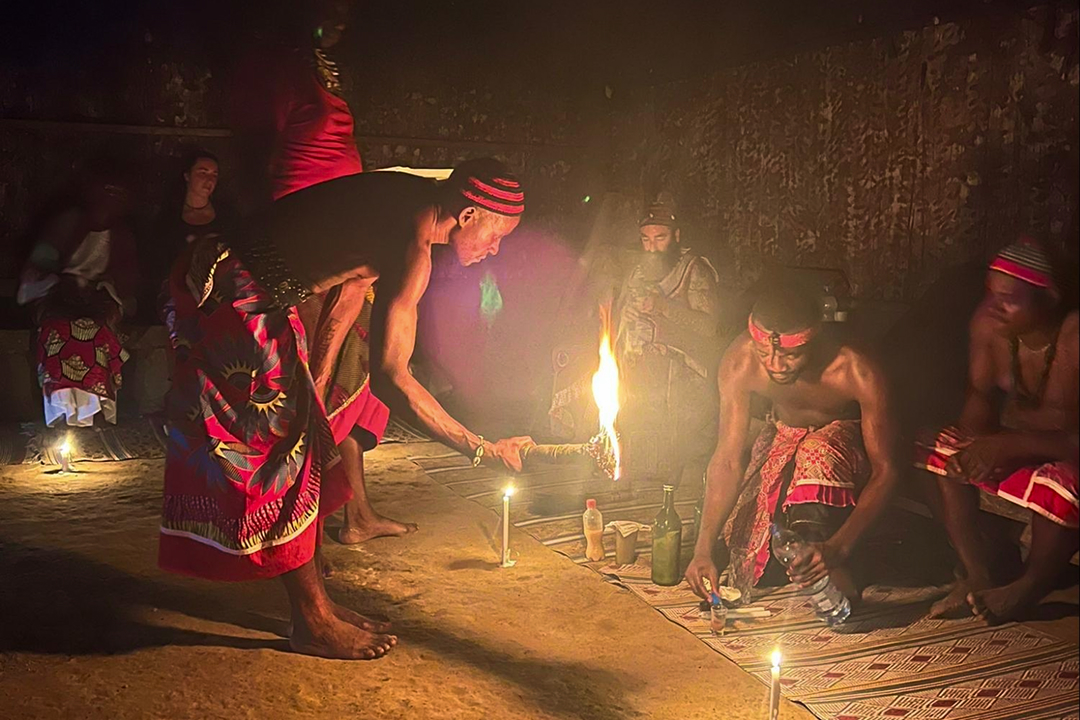
Iboga, on the other hand, is served in a ceremonial environment that honors thousands of years of Bwiti tradition.
The Bwiti people have been studying life with Iboga for millennia, literally using this medicine to explore consciousness, identity, truth, and the blueprint of the human mind. When you sit with Iboga traditionally, you are not just taking a plant; you are tapping into this ancient lineage and its accumulated wisdom.
A traditional Iboga ceremony includes:
- Bwiti music that guides the mind
- Fire, which provides clarity and protection
- Rituals that open and close the spiritual space
- Proper dosing that follows Bwiti methodology
- Teachings that show you how the mind works
- Guidance so you know what the medicine is showing you
This context dramatically deepens the experience. Without it, you’re missing a huge part of what makes Iboga the powerful, life-changing medicine it is.
Which One Should You Choose?
Here is the simplest way to think about it:
Choose Ibogaine if:
- You are in active addiction
- You need detox support
- You need an addiction “interrupt” quickly
Ibogaine is extremely effective for this purpose.
Choose Iboga if:
- You want spiritual healing
- You want emotional or physical healing
- You want to understand yourself, your mind, and your life
- You want to connect with traditional Bwiti ceremony
- You want the full medicine—not just the isolated alkaloid
For almost everyone outside acute addiction treatment, Iboga in a traditional Bwiti ceremony is the deeper, more comprehensive path.
The Bottom Line
Ibogaine is the molecule.
Iboga is the medicine.
Ibogaine works on the brain.
Iboga works on the brain, body, heart, and soul.
And while Ibogaine is powerful for detox, only the whole plant—served traditionally—delivers the spiritual, psychological, and energetic benefits that have made Iboga one of the most revered master medicines on Earth.
